
Corneal GP Contact Lenses vs. Laser Eye Surgery
If you're thinking about refractive surgery as an alternative to contact lenses, you'll want to consider the visual acuity that each provides, as well as the risks and benefits.
LASIK and other forms of refractive surgery have the benefit of providing satisfactory vision without, in most cases, the need for post-surgery glasses or contact lenses.
However, LASIK carries the risk of a permanent reduction in visual acuity, or "vision loss" in eye doctor lingo. In other words, your vision may be worse after the surgery, even when corrected by glasses.
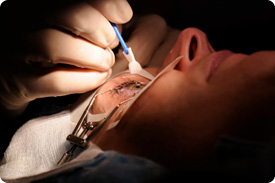
Several recent reports about LASIK indicate that vision loss is experienced by 0.4% to 2% of all individuals who have undergone the procedure, or as many as 1 in 50 people.
There is a risk of vision loss with contact lenses as well, but it's much smaller. Each year about 1 in 16,000 wearers (about 0.006%) experiences a reduction in visual acuity due to complications of contact lens wear.
Permanent vision loss is not the only complication associated with LASIK. Undesirable glare, reduction in quality of night vision, and dry eye syndrome occur more often than loss of vision and can be frustrating to those who have had this procedure. In addition, some patients need further surgeries, called "enhancements," to achieve better vision.
Corneal GP Lenses Preserve Your Options
Contact lenses, notably corneal GP contact lenses, offer optimal vision and can be adjusted to maintain optimal vision as the eyes change. In addition, they can provide multifocal optics, enabling vision at all distances for individuals with presbyopia who require a range of corrective powers in the same lens.
LASIK doesn't provide such a benefit. If you're presbyopic and have LASIK, your only options are to wear reading glasses or to have another surgical procedure resulting in monovision.
It makes sense to try contact lenses before making an irreversable change with LASIK.
GPs After Refractive Surgery
If you choose to have LASIK, you may become a corneal GP lens wearer as well. Corneal GP contact lenses can help people who've had LASIK but did not achieve an optimal outcome, notably those whose post-surgery, irregular corneas result in high astigmatism or keratoconus.
In one recent study of 74 such eyes from 45 refractive surgery patients, the average best-corrected vision with glasses was worse than 20/100.
From 75% to 80% of these individuals were successfully fitted with GP lenses, with 75% to 80% of them achieving better than 20/40 vision.
(Soft contact lenses, which simply drape over the irregular surface of eyes that have been compromised by surgery, would have provided little benefit for these individuals.)
It is important to emphasize that both contact lenses and refractive surgery have risks. Your eye care practitioner should advise you of the magnitude of risk for individuals like you, especially if refractive surgery is being considered.
The overwhelming majority of contact lens complications — especially with respect to corneal GPs — are minor, rarely sight-threatening, and often preventable with proper lens care and adherence to the prescribed wearing schedule.