
Astigmatism
Astigmatism is a refractive condition that occurs due to variations in the curvature of the eye. Astigmatism is a very common refractive condition, but the mechanism that leads to the development of astigmatism is still unclear. Astigmatism development is likely influenced by both genetic and environmental factors.1 Uncorrected astigmatism can lead to a variety of symptoms including: distance and near blurry vision, starbursts and halos around lights, difficulty driving at night, etc. In cases of high astigmatism, patients may experience some blur or distortions to vision even when wearing glasses.1 Specialty contact lenses offer optimal vision for patients with high astigmatism, and many patients with varying levels of astigmatism prefer their vision in specialty contact lenses versus glasses. Depending on the level of astigmatism, patients can be fit in custom soft, corneal gas permeable (GP), or scleral lenses.
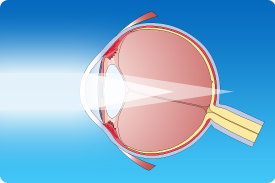
Astigmatism creates multiple points of focus from light entering the eye. This results in blurred vision, which is correctable with contact lenses or glasses.
Contributed by: Dr. Sam Schlesman
References
- Read S.A., Vincent S.J., Collins M.J. The visual and functional impacts of astigmatism and its clinical management. Ophthalmic Physiol Opt. 2014 May;34(3):267-94.
Available at: https://pubmed.ncbi.nlm.nih.gov/24635572/