
Myopia and Hyperopia
Are you tired of wearing thick, heavy glasses? There are many contact lens options available for your needs! Specialty contact lenses can be a great option for patients with high refractive error that want an alternative to wearing glasses every day. Specialty contact lenses can offer optimal vision compared to glasses, especially in patients with prescriptions.
Myopia
Myopia, or nearsightedness, is a common refractive error in the general population. Myopia is when someone cannot see clearly at distance without some form of optical correction and is generally due to an elongated eye. Myopia can be corrected with glasses, contact lenses, and in some cases, refractive surgeries. Out of the general myopic population, about 20% to 24% have high myopia, which is considered a prescription greater than -6.00D.1
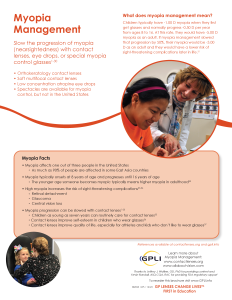
Download a brochure about slowing the progression of myopia
Hyperopia
Hyperopia, or farsightedness, usually occurs as a result of a shortened eyeball and can be corrected with glasses, contact lenses, and in some cases, refractive surgeries. When present in childhood, high or severe hyperopia can be associated with problems with the eye’s focusing system (accommodation) or the ability for the two eyes to work together (binocular vision) and may lead to eye turns or amblyopia, when best corrected vision is worse than 20/20.2 To prevent these problems from occurring, it is important for the patient to use some form of visual correction. Like highly myopic patients, high hyperopic patients are great candidates for specialty contact lenses, as they offer crisp vision without needing to wear thick, heavy glasses.
Contributed by: Dr. Sam Schlesman
References
- Pie-Chang W., Hsiu-Mei H., Hun-Ju Y., et al. Epidemiology of Myopia. Asia-Pacific Journal of Ophthalmology. 2016; 5(6): 386-393.
Available at: https://www.sciencedirect.com/science/article/pii/S2162098923003341?via%3Dihub - Castagno, V.D. et al. Hyperopia: a meta-analysis of prevalence and a review of associated factors among school-aged children. BMC Ophthalmology 2014, 14:163
Available at:
https://pubmed.ncbi.nlm.nih.gov/25539893/