
Corneal and Iris Disfigurements
Are you currently unhappy or insecure with the appearance of your eyes? Prosthetic contact lenses can improve ocular aesthetics for patients that have congenital defects or have had certain eye injuries, infections, or surgical complications.1 Patients with corneal and/or iris damage can experience blurry vision, light sensitivity, glare, and poor cosmetic appearance.2
Prosthetic contact lenses offer therapeutic advantages and improve aesthetics by masking ocular defects and making it look as close to a “normal” eye as possible. Prosthetic contact lenses can not only improve the cosmetic appearance of your eyes, but they can enhance your quality of life. With a properly fitting prosthetic contact lens, you can feel more confident in your day to day life.
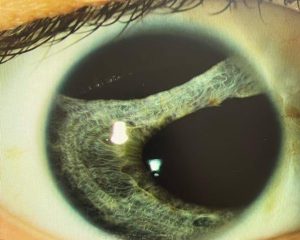
Figure 1. Patient with a deformed iris due to trauma. A soft prosthetic contact lens would be a great option for this patient to reduce their light sensitivity and improve appearance.
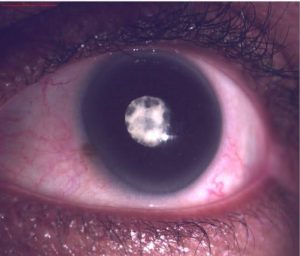
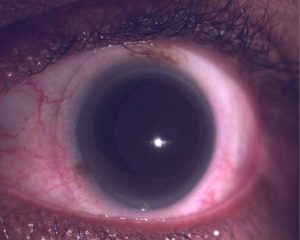
Figure 2. Patient with hypermature cataract (left) fit with a pupil-occluded soft prosthetic contact lens to improve ocular appearance (right).
Contributed by: Dr. Sam Schlesman
References
- Yildirim, N., Basmak, H., and Sahin, A. Prosthetic Contact Lenses: Adventure or Miracle. Eye & Contact Lens: Science & Clinical Practice. 2006 March; 32(2): 102-103.
Available at: https://pubmed.ncbi.nlm.nih.gov/16538133/ - Chung, M., Miller, K., Weissman, B. Morcher Iris Reconstruction Lens and Rigid Contact Lens for Traumatic Aniridia. Eye & Contact Lens. 2009;2: 108-110.
Available at: https://pubmed.ncbi.nlm.nih.gov/19265334/